
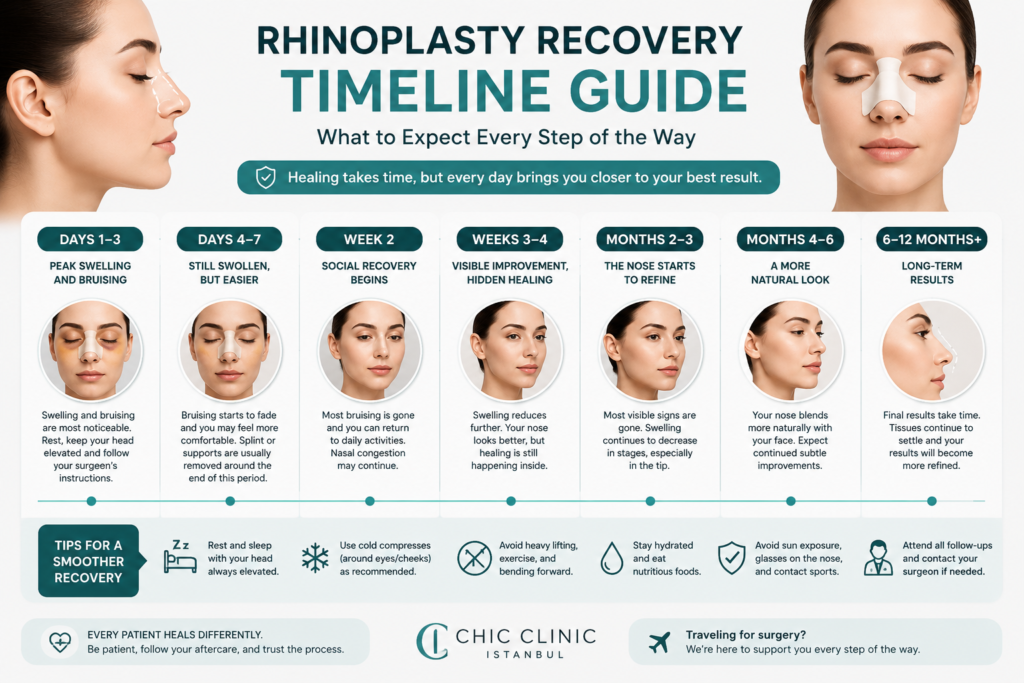
The first few days after nose surgery are usually the part patients worry about most – not because recovery is unmanageable, but because they do not know what is normal. A clear rhinoplasty recovery timeline guide can make the process feel far more predictable. If you are traveling for surgery, that clarity matters even more because you want to know when swelling peaks, when bruising improves, and when you may feel comfortable flying home.
Recovery after rhinoplasty is not one straight line. Some patients look presentable quickly and still feel congested for weeks. Others bruise more in the beginning but settle nicely after that. The details depend on your skin thickness, the extent of the procedure, whether the surgeon worked on the bridge, tip, or septum, and how closely you follow aftercare instructions. Still, there is a reliable timeline most patients can use as a practical reference.
Rhinoplasty recovery timeline guide: what to expect first
Right after surgery, your nose will usually have a splint on the outside, and in some cases there may be internal support as well. You can expect swelling, pressure, congestion, and mild drainage during the first 24 to 72 hours. Most patients describe this stage as uncomfortable rather than painful. The bigger issue is often breathing through the nose, which can feel limited at first.
You will likely spend this early period resting with your head elevated, using cold compresses around the cheeks and eyes if your surgeon allows it, and avoiding anything that increases pressure in the face. That means no heavy lifting, no bending forward, and no intense activity. If you are an international patient, this is also the stage when coordinated support makes a real difference. Simple things like hotel comfort, transfer planning, and clear communication can reduce stress while you focus on healing.
Days 1 to 3: peak swelling and bruising
For many patients, swelling and bruising are most noticeable during the first two to three days. The area around the eyes can look puffy, and bruising may appear darker before it starts fading. This can be alarming if you were expecting daily improvement from the first morning, but it is a normal part of the process.
Your nose itself will not look like the final result. In fact, it may look wider, more upturned, or less refined than expected because tissues are reacting to surgery. This is where patience matters. Judging the outcome this early usually causes unnecessary anxiety.
Hydration, rest, and following medication instructions are the priority here. You should also avoid wearing glasses on the nose unless your surgeon gives specific guidance, and you should be gentle with washing and clothing changes so you do not bump the area.
Days 4 to 7: still swollen, but easier
By the middle of the first week, many patients start feeling more like themselves. Bruising often begins to shift in color and soften. Swelling is still present, but the pressure may ease. If you had packing or internal supports, the experience can change noticeably once those are removed, depending on your case.
This is often the period when patients ask whether they are healing normally because they see small asymmetries. One nostril may look different from the other. The tip may appear stiff. The bridge may seem uneven. Early healing can be irregular, and that does not automatically mean anything is wrong.
If your splint is removed around one week, you may feel excited to see your nose for the first time – and slightly surprised. Most noses look swollen at this stage. Think of it as an early preview, not the finished result.
Week 2: social recovery begins
Week two is when many people feel comfortable being seen in public again. Bruising is often much lighter or can be covered more easily, and the most dramatic swelling has usually gone down. You may still feel nasal stuffiness, especially in the mornings, and the tip can remain firm.
From a travel perspective, this is an important stage. Many international patients plan their stay around early follow-up, splint removal, and the point when they feel presentable enough for the trip home. It depends on your surgeon’s advice and your individual recovery, but this is often when logistics become more manageable.
That said, looking better is not the same as being fully healed. Your nose is still vulnerable to impact, pressure, and unnecessary strain. You should continue avoiding intense workouts, contact sports, and anything that risks accidental injury.
Weeks 3 to 4: visible improvement, hidden healing
By the end of the first month, you will likely notice that your nose already looks significantly better than it did in the first week. Friends or family may assume you are fully recovered. Under the surface, though, healing is still active.
Swelling during this stage tends to be more subtle. Instead of obvious puffiness around the eyes, it may collect mostly in the tip or along specific areas of the nose. Patients with thicker skin often notice that the tip definition takes longer to appear. Patients with thinner skin may see refinement earlier but also become more aware of tiny irregularities that usually settle over time.
This is also the point where some patients become impatient. They expect a polished result after one month, but rhinoplasty rarely works that way. A nose can look good at four weeks and still continue improving for many months.
Month 2 to Month 3: the nose starts to refine
Around the second and third month, most of the obvious public-facing signs of surgery have faded. Daily life feels normal for many patients, and swelling continues to reduce in stages. You may notice that your nose looks different in the morning than it does at night, or sharper one week and puffier the next. Small fluctuations are common.
This phase is often emotionally easier because the result begins to make more sense. The bridge may look cleaner, the profile more balanced, and the swelling less distracting. The tip, however, can still be the slowest area to settle. That is especially true in revision cases or more complex reshaping.
If you had rhinoplasty to improve both appearance and breathing, this period may also bring a clearer sense of functional improvement. Internal swelling can take time to calm down, so breathing changes are not always immediate.
Months 4 to 6: a more natural look
By this stage, the nose usually starts blending naturally with the rest of the face. The result looks less like a post-surgery nose and more like your nose, just more balanced. Most patients feel confident in photos, social settings, and regular routines by now.
Still, healing is not identical for everyone. A patient with thick skin, major tip work, or a revision procedure may still have noticeable residual swelling. A patient with a smaller adjustment may feel nearly finished earlier. This is why comparing your timeline too closely to someone else’s recovery can be misleading.
The long view: 6 to 12 months and beyond
A true rhinoplasty recovery timeline guide has to include the part patients often underestimate – final refinement takes time. Many surgeons advise waiting up to a full year to judge the result, and sometimes longer for tip work or revision surgery. That does not mean you will look swollen for a year. It means the last percentages of definition and softness arrive gradually.
This long healing window is normal, not a sign that something is wrong. Cartilage, skin, and soft tissue all settle at different speeds. The nose becomes less stiff, finer in detail, and more natural in movement over time.
What can affect your recovery timeline?
Several factors can speed up or slow down healing. Surgical technique matters, as does whether your procedure was primary or revision rhinoplasty. Skin thickness, age, general health, smoking, sun exposure, and aftercare compliance all play a role.
Travel timing matters too. If you are planning surgery abroad, it helps to work with a team that organizes your consultation, follow-up planning, and local support clearly. For patients coming to Istanbul, Chic Clinic Istanbul focuses on making that process feel coordinated from the first photo review to post-op guidance, which can make recovery less stressful when you are away from home.
When should you contact your surgeon?
Some swelling, bruising, congestion, and asymmetry are expected. But severe bleeding, sudden worsening pain, fever, signs of infection, or trauma to the nose should be reported promptly. It is always better to ask early than to sit with unnecessary worry.
A good recovery experience is not only about the surgery itself. It is also about knowing what is normal, what needs attention, and who to contact if you have questions. That reassurance matters, especially when you have traveled for treatment.
Rhinoplasty asks for patience, but the process is usually easier once you know what each stage tends to look like. Give your nose time, protect it carefully, and let the result reveal itself gradually – the best changes in rhinoplasty often happen quietly, month by month.