
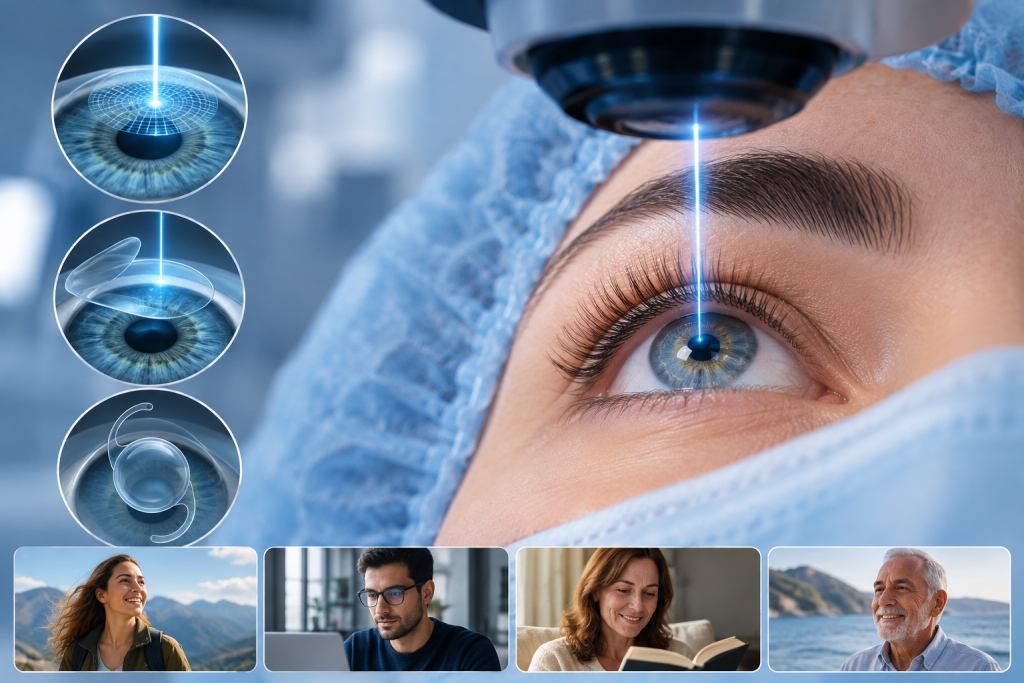
Types of eye surgery today include LASIK, laser vision correction procedures and intelligent lens surgery, offering different options for people who want clearer vision and less dependence on glasses or contact lenses.
However, not every procedure is suitable for every patient. Age, prescription stability, corneal thickness, eye health, presbyopia and the condition of the natural lens all play an important role in determining the most appropriate treatment.
In this guide, we explain the main types of vision correction surgery and which age groups may be suitable for each option.
What Is Laser Eye Surgery?
Laser eye surgery is a general term for procedures that use laser technology to reshape the cornea and correct refractive errors such as:
- Myopia (nearsightedness)
- Hyperopia (farsightedness)
- Astigmatism
Different techniques can be used depending on the patient’s eyes and prescription. LASIK is one of the best-known forms of laser vision correction.
Laser treatment does not replace the natural lens of the eye. Instead, it changes the shape of the cornea so that light can focus more accurately on the retina.
What Is LASIK Eye Surgery?
LASIK (Laser-Assisted In Situ Keratomileusis) is a refractive procedure in which the cornea is reshaped with a laser to correct vision.
During LASIK, a thin corneal flap is created. The underlying corneal tissue is then reshaped using an excimer laser, after which the flap is repositioned.
LASIK can be used for suitable patients with myopia, hyperopia and astigmatism. FDA-approved LASIK systems have specific treatment ranges, so suitability depends not only on age but also on the patient’s prescription and the laser platform being used.
What Is the Best Age for LASIK?
LASIK is generally performed only in adults. The FDA states that no LASIK lasers are approved for people under 18. In practice, stability of the prescription is particularly important, and ophthalmic guidance notes that treatment is often deferred until after age 21 because refractive changes may still occur in younger patients.
For this reason, approximately 21 to 40 years old is often a favorable period for LASIK in appropriately selected patients.
There is no strict upper age limit for LASIK. However, after around age 40, presbyopia gradually becomes an important consideration. A patient may achieve excellent distance vision after LASIK but still require reading glasses.
Laser Vision Correction Between Ages 20 and 40
For younger adults with a stable prescription and healthy corneas, corneal laser procedures are often among the options considered first.
Before treatment, the ophthalmologist evaluates factors such as:
Corneal thickness and shape: A healthy and sufficiently thick cornea is important for many laser procedures.
Prescription stability: The prescription should generally have remained stable before surgery. FDA labeling for several LASIK systems requires documented stability for at least one year.
Eye health: Conditions affecting the cornea or other parts of the eye can make laser surgery unsuitable.
Therefore, age alone cannot determine whether someone is a good candidate for laser eye surgery.
What Happens to Vision After Age 40?
Around the age of 40, many people begin experiencing presbyopia, the age-related decline in the eye’s ability to focus on nearby objects.
Typical symptoms include:
- Difficulty reading small text
- Holding a phone farther away to read
- Needing stronger light for close work
- Switching between distance and reading glasses
This changes the discussion about refractive surgery.
Traditional LASIK can correct distance refractive errors, but it does not stop the natural aging of the lens. For selected patients with early presbyopia, specialized corneal approaches such as PresbyLASIK may be considered; EyeWiki describes patients roughly 40–55 years old with clear natural lenses as a potential candidate group.
What Is an Intelligent Lens or Smart Lens?
The terms Intelligent Lens and Smart Lens are commonly used in medical tourism and patient-facing communication for advanced intraocular lenses.
Unlike LASIK, this procedure works inside the eye.
The natural lens is removed and replaced with an artificial intraocular lens (IOL). Depending on the patient’s needs, different lens designs may be used, including:
- Monofocal lenses
- Multifocal lenses
- Trifocal lenses
- Extended Depth of Focus (EDOF) lenses
Presbyopia-correcting IOLs are used both in cataract surgery and in refractive lens exchange to reduce refractive errors and, with suitable lens designs, provide vision over more than one distance.
At What Age Is Intelligent Lens Surgery Suitable?
There is no single age that automatically makes someone suitable for an Intelligent Lens.
In general, lens-based solutions become more relevant as patients develop presbyopia, age-related lens changes or cataracts. For younger patients whose natural lens is still clear and flexible, preserving that natural lens may be preferable unless there is a specific clinical reason for lens surgery.
As patients move through their 40s and 50s, the decision becomes more individualized. By the time significant presbyopia or cataract-related changes are present, an intraocular-lens approach may offer advantages that corneal laser surgery cannot provide.
For patients over 60, lens-based treatment is often particularly relevant because cataract and age-related changes in the natural lens become increasingly important. EyeWiki similarly notes that patients over 60 may be better candidates for intraocular refractive approaches than PresbyLASIK.
LASIK vs Intelligent Lens: What Is the Difference?
The fundamental difference is where the correction takes place.
With LASIK and other corneal laser procedures, the surgeon reshapes the cornea, while the patient’s natural lens remains inside the eye.
With Intelligent Lens surgery, the natural lens is removed and replaced with an artificial intraocular lens.
This distinction becomes increasingly important with age. A young adult may have a healthy, flexible natural lens but a refractive error that can potentially be corrected at the corneal level. An older patient may have presbyopia or cataract-related lens changes, making the natural lens itself part of the vision problem.
Types of Eye Surgery by Age: Which Procedure Is Suitable?
As a simplified guide:
Under 18: Refractive laser surgery such as LASIK is generally not performed; FDA-approved LASIK lasers are for adults.
18–21: Some LASIK systems are approved from age 18, but prescription stability is essential, and many patients may benefit from waiting until their refraction has stabilized.
21–40: LASIK or another appropriate corneal laser procedure may be considered if the prescription is stable and the cornea and eyes are healthy.
40–50: Both distance vision and presbyopia need to be considered. Depending on the eye, lifestyle and expectations, laser-based or presbyopia-oriented options may be discussed.
50–60: Lens-based treatments become increasingly relevant, particularly when presbyopia is significant or the natural lens is beginning to change.
60+: Cataract status becomes especially important. For many patients requiring surgery, an intraocular lens can simultaneously replace the aging or cataractous natural lens and provide the selected optical correction.
These age ranges are general guidance rather than fixed rules. Two people of the same age may require completely different treatments.
Can Everyone Have LASIK or Intelligent Lens Surgery?
No. A complete ophthalmological examination is necessary before deciding on any procedure.
For LASIK, factors such as corneal abnormalities, unstable prescription and certain ocular or systemic conditions can affect candidacy.
For lens surgery, the ophthalmologist must assess the retina, cornea, optic nerve, natural lens, eye measurements and the patient’s visual expectations before selecting an IOL.
It is also important to understand that no surgical technique can guarantee completely glasses-free vision for every patient.
How Is the Right Eye Surgery Selected?
The best treatment is not determined by age alone.
A comprehensive eye examination should consider:
Age + prescription + corneal structure + natural lens condition + eye health + lifestyle + visual expectations.
For example, a 45-year-old with a completely clear natural lens may receive a different recommendation from another 45-year-old with significant lens changes. Similarly, two 25-year-old patients with the same prescription may have different options because their corneal thickness or topography differs.
Eye Surgery in Istanbul
Istanbul has become an international destination for ophthalmology and medical tourism. Patients travelling from abroad may undergo their examination, diagnostic testing and treatment as part of a coordinated medical trip.
At Chic Clinic Istanbul, the appropriate treatment should be determined only after detailed ophthalmological assessment. Rather than choosing LASIK, laser treatment or an Intelligent Lens based simply on age or advertising, the objective is to identify the option that matches the patient’s individual eye structure and visual needs.
Conclusion
Among the different types of eye surgery, LASIK, laser vision correction and Intelligent Lens surgery can all reduce dependence on glasses in appropriately selected patients, but they work in different ways and are suited to different eye conditions.
For many younger adults with stable prescriptions and healthy corneas, LASIK or another laser vision correction technique may be considered. As presbyopia and age-related changes of the natural lens develop, lens-based treatments such as advanced intraocular lenses may become increasingly relevant.
There is therefore no universal “best eye surgery” for a particular age. The safest approach is to select treatment after a complete eye examination and individualized evaluation.