
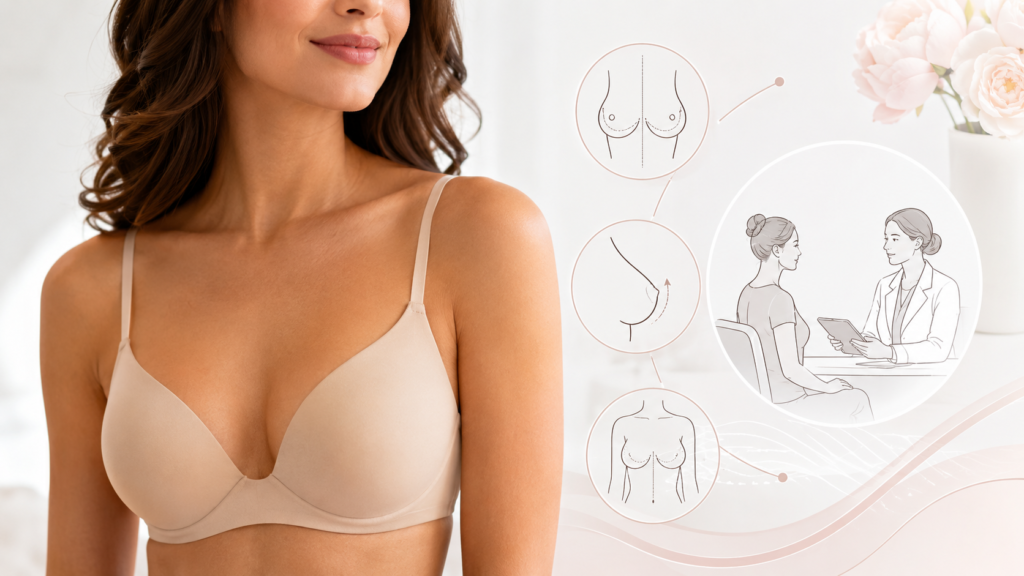
Breasts rarely change for just one reason. Pregnancy, weight loss, aging, genetics, and skin quality all play a role, which is why the best breast lift options are never one-size-fits-all. What works beautifully for one patient may leave another wishing she had chosen a different approach. The right plan starts with your anatomy, your goals, and how much change you actually want to see.
For many women, the real question is not simply, “Do I need a lift?” It is, “Do I want more upper fullness, smaller areolas, better symmetry, or a firmer position without looking overdone?” Once those goals are clear, the treatment path becomes much easier to choose.
What a breast lift actually changes
A breast lift, or mastopexy, is designed to raise and reshape the breast by removing excess skin and repositioning the nipple to a more youthful height. It can improve sagging, stretched skin, downward-pointing nipples, and breasts that have lost shape after pregnancy or weight changes.
What it does not do on its own is create major volume. That distinction matters. If your main concern is drooping but you still like your breast size, a lift alone may be enough. If you want more fullness, especially in the upper part of the breast, a lift combined with implants or fat transfer may be the better answer.
Best breast lift options based on your goals
The best breast lift options usually fall into a few proven categories. The difference comes down to how much sagging is present, how much reshaping is needed, and whether volume should be added or reduced at the same time.
Crescent lift
This is the most limited lift technique and is usually reserved for very mild sagging. A small crescent-shaped piece of skin is removed above the areola, allowing for a subtle nipple elevation.
It sounds appealing because the scar is minimal, but it is not appropriate for most patients with visible drooping. If your nipples sit clearly below the breast crease or the skin envelope is stretched, this option will likely not deliver enough improvement.
Donut lift
Also called a periareolar lift, this technique places an incision around the edge of the areola. It can help with mild sagging and is sometimes chosen when the patient also wants a reduction in areola size.
The trade-off is that while the scar can blend around the areola border, the lifting power is still limited. In some patients, it may also flatten the breast shape if used in cases that really need a stronger lift.
Vertical lift
Often called the lollipop lift, this technique uses an incision around the areola and a vertical line down to the breast fold. It offers more reshaping than a donut lift and is a common choice for moderate sagging.
This option gives surgeons more control over contour and nipple position while avoiding the longer horizontal scar used in more extensive lifts. For many patients, it strikes a strong balance between scar length and visible improvement.
Anchor lift
The anchor, or inverted-T lift, is the most comprehensive option for significant sagging. It includes an incision around the areola, vertically down the breast, and along the breast crease.
This technique is often the best choice after major weight loss, multiple pregnancies, or substantial skin laxity. While it does involve more scarring, it also allows the greatest degree of reshaping, skin removal, and correction of droop. For the right candidate, the improvement can be dramatic and worth the extra incision length.
Lift alone or lift with implants?
This is one of the most common decision points. A breast lift alone repositions and reshapes existing tissue, but it cannot create the rounded upper fullness that many patients associate with a more augmented look.
If you are happy with your size in a bra but dislike the lower position or emptier shape, a lift alone may be the most natural option. If you have lost volume after breastfeeding or weight loss and want fuller cleavage or a more projected upper pole, combining the lift with implants may make more sense.
The benefit of combining procedures is obvious – shape and volume can be improved in one plan. The trade-off is that implant selection adds another layer of decision-making, and not every patient needs that extra step. In some cases, patients initially ask for implants but realize during consultation that what they really want is a lift with better contour.
Lift with fat transfer
For patients who want a modest increase in volume without implants, fat transfer can be part of the discussion. Fat is taken from another area of the body and used to add subtle fullness to the breasts.
This approach appeals to patients who prefer a more natural alternative and already have enough donor fat available. Still, it has limits. Fat transfer does not create the same structured fullness as an implant, and not all transferred fat survives long term. It can be an excellent add-on in selected cases, but it is not a substitute for implants when a significant size increase is the goal.
Lift with breast reduction
Some women do not want more volume at all. They want relief from heaviness, skin irritation, bra strap grooves, and a breast shape that sits higher and feels easier to carry. In these cases, a breast lift with reduction can be the most effective option.
This approach removes excess tissue while lifting and reshaping the breast. It often improves comfort as much as appearance. If larger breasts are contributing to back, neck, or shoulder discomfort, reducing size while restoring position can deliver a more complete result than a lift alone.
How surgeons decide which option suits you
The most useful evaluation is not based on photos alone, although photos are an important starting point. A surgeon looks at nipple position, skin elasticity, breast volume, asymmetry, chest shape, tissue quality, and how much upper fullness you want after healing.
That is why two women with “sagging breasts” may receive very different recommendations. One may be a strong candidate for a vertical lift alone. Another may need an anchor lift with implants to achieve the look she has in mind. The right plan depends on the gap between your current shape and your desired result.
For international patients, this early assessment needs to be organized and realistic. At Chic Clinic Istanbul, many patients begin with a WhatsApp consultation and photo review so the team can understand the case, discuss likely options, and help the patient plan the trip with clearer expectations from the start.
What recovery usually looks like
Most patients can expect swelling, tightness, and soreness in the early recovery period. The first days are more about rest, support garments, and careful movement than pain itself. Many patients describe the discomfort as manageable rather than severe.
You will need to avoid heavy lifting, intense exercise, and sleeping in positions that put pressure on the chest. Final shape also takes time. Breasts settle gradually, scars continue to mature, and symmetry becomes easier to judge after swelling improves.
If you are traveling for surgery, recovery planning matters just as much as procedure choice. Airport timing, hotel support, local transfers, and follow-up communication should feel organized before you book. A coordinated patient journey reduces stress and lets you focus on healing rather than logistics.
Scars, expectations, and long-term results
Every breast lift creates scars. The question is not whether scars exist, but whether the trade-off is worthwhile for the improvement in position and shape. For most patients, the answer is yes, especially once scars fade and the breast contour looks more balanced in and out of clothing.
Results are long-lasting, but no breast lift stops future aging, gravity, pregnancy changes, or weight fluctuations. Stable weight, supportive bras, and realistic expectations all help preserve the outcome. If your lifestyle or family plans suggest major body changes ahead, timing the procedure thoughtfully can make a difference.
Choosing between the best breast lift options
The best breast lift options are the ones that match your body instead of forcing your body to match a trend. A smaller scar is not automatically better if it leaves too much sagging behind. A bigger procedure is not automatically better if your concerns are mild and your natural volume already looks good.
A strong consultation should leave you understanding not only what can be done, but why that specific option fits you. That level of clarity matters even more when you are planning surgery abroad and want the process to feel safe, structured, and personally guided.
If you are considering a breast lift, focus on the result you want to live with every day – better position, better proportion, and a shape that feels like you again. The right option should give you confidence before surgery, not confusion.