
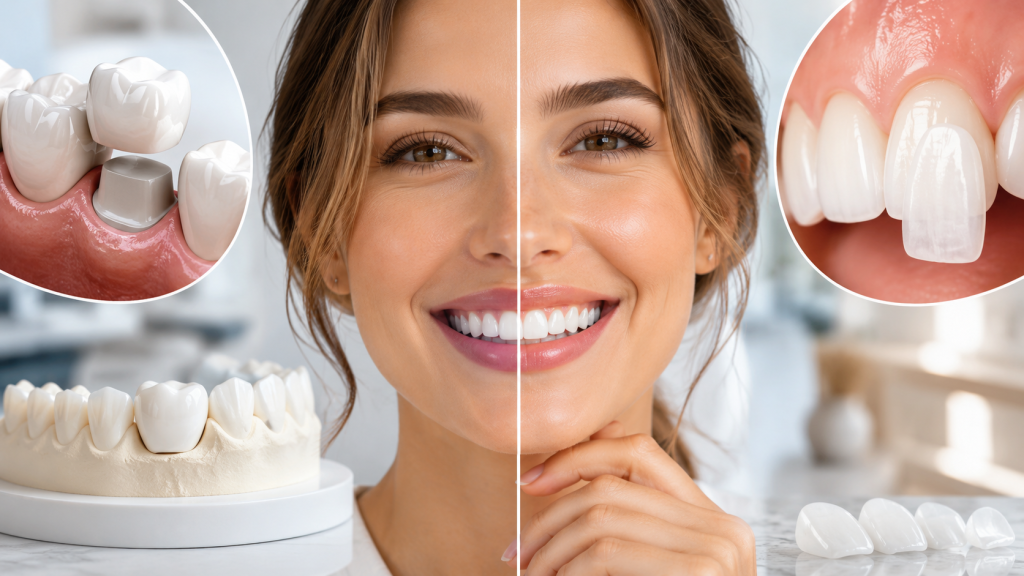
A beautiful smile is one of the most powerful elements of facial aesthetics. Today, modern cosmetic dentistry offers several effective solutions for improving the shape, color, alignment, and overall appearance of teeth. Among the most popular treatments are zirconium crowns and dental veneers.
Although both treatments can create a bright, natural-looking smile, they are not the same. Each option has its own purpose, advantages, limitations, and ideal candidates. Understanding the difference between zirconium crowns and veneers helps patients make a safer and more informed decision.
What Are Zirconium Crowns?
Zirconium crowns are full-coverage dental restorations made from a strong ceramic material called zirconia. A zirconium crown covers the entire visible part of the tooth, providing both aesthetic improvement and structural protection.
This treatment is commonly used when teeth are severely damaged, heavily filled, weakened, discolored, misshaped, or after root canal treatment. Zirconium crowns are also a popular choice for patients who want a complete smile makeover with high durability and a natural appearance.
Advantages of Zirconium Crowns
One of the biggest advantages of zirconium crowns is their strength and durability. Zirconia is highly resistant to chewing forces, making it suitable for both front and back teeth.
Zirconium crowns also offer excellent aesthetic results. They can be designed to match the natural color, shape, and translucency of the patient’s teeth. Since zirconium does not contain metal, there is no dark grey line near the gums, which can sometimes appear with traditional metal-supported crowns.
Another important advantage is biocompatibility. Zirconium is generally well tolerated by gum tissue and is less likely to cause irritation or allergic reactions.
Disadvantages of Zirconium Crowns
The main disadvantage of zirconium crowns is that they require more tooth preparation compared to veneers. Since the crown covers the entire tooth, a certain amount of enamel must be removed to create enough space for the restoration.
For patients with healthy, minimally damaged teeth, this may be considered a more invasive option. Once a tooth is prepared for a crown, it will always need a crown or similar restoration in the future.
Zirconium crowns are also usually more expensive than some basic cosmetic treatments, depending on the clinic, materials, laboratory quality, and the number of teeth treated.
What Are Dental Veneers?
Dental veneers are thin shells, usually made of porcelain or composite material, that are bonded to the front surface of the teeth. Unlike crowns, veneers do not cover the entire tooth. They mainly improve the visible front part of the smile.
Veneers are ideal for patients who have generally healthy teeth but want to improve cosmetic concerns such as mild discoloration, small gaps, minor shape irregularities, slightly worn edges, or uneven tooth size.
Advantages of Veneers
The biggest advantage of veneers is that they are more conservative than crowns. In many cases, only a small amount of enamel is removed, and sometimes minimal-prep or no-prep veneers may be possible.
Veneers can provide a very natural and elegant result, especially when made from high-quality porcelain. They reflect light similarly to natural enamel and can dramatically improve the smile without heavily altering the tooth structure.
Another advantage is that veneers are excellent for smile design. They can correct color, shape, size, and minor alignment issues in a relatively short time.
Disadvantages of Veneers
Veneers are not suitable for every patient. If the teeth are severely damaged, heavily filled, very weak, or badly positioned, veneers may not provide enough support or coverage.
They are also more delicate than full crowns. Patients who grind their teeth, bite their nails, or use their teeth to open objects may be at higher risk of veneer fracture or debonding.
Another limitation is that veneers only cover the front surface of the teeth. If the tooth needs full protection or has major structural problems, a crown may be a better option.
Zirconium Crowns vs. Veneers: Which One Is Better?
There is no single answer to this question because the best option depends on the patient’s dental condition, aesthetic expectations, bite structure, oral hygiene, and long-term treatment goals.
Zirconium crowns are usually better for teeth that are weak, damaged, heavily restored, root canal treated, or in need of full coverage.
Veneers are usually better for healthy teeth that only need cosmetic improvement on the front surface.
In simple terms, veneers are more conservative and aesthetic-focused, while zirconium crowns offer more strength, coverage, and protection.
Final Recommendation
Choosing between zirconium crowns and veneers should always be done after a detailed dental examination. A professional dentist will evaluate the teeth, gums, bite, enamel condition, and smile design expectations before recommending the most suitable treatment.
At a modern dental clinic, the goal should not be only to create white teeth, but to design a smile that looks natural, functions properly, and remains healthy for many years.
Both zirconium crowns and veneers can create beautiful results when planned correctly. The key is choosing the right treatment for the right patient.