
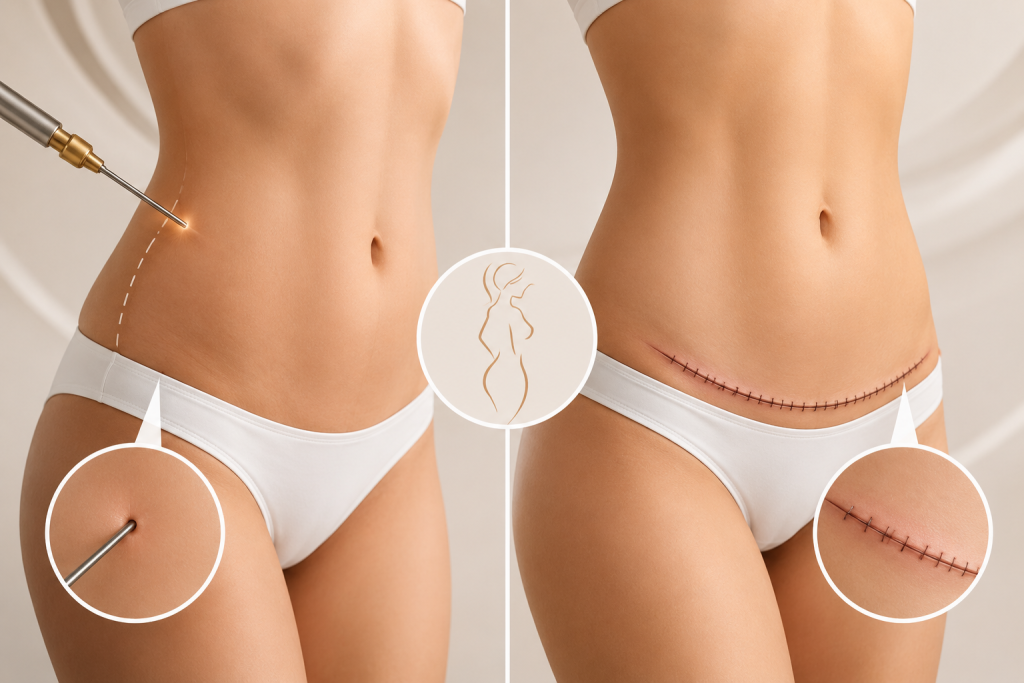
Many patients who want a flatter stomach, slimmer waist, or more defined body shape often ask the same question: Do I need liposuction or a lift? At first, these procedures may sound similar because both can improve body contour. However, they are completely different surgeries with different goals, different techniques, and different types of scars.
Understanding the difference between liposuction and body lift surgery is important before deciding which treatment is right for you.
What is liposuction?
Liposuction is a body contouring procedure designed to remove stubborn fat from specific areas of the body. It is commonly performed on the abdomen, waist, back, arms, thighs, chin, and hips.
During liposuction, the surgeon makes very small openings in the skin. Through these tiny holes, a thin tube called a cannula is inserted to break down and remove excess fat. These openings are usually only a few millimeters long and are placed in discreet areas whenever possible.
This means that liposuction usually does not involve large incisions, long cuts, or major visible scars. The marks are typically very small and often fade significantly over time.
Liposuction can create a slimmer, more sculpted body shape, but it does not remove loose skin. This is one of the most important points patients need to understand.
What is a body lift?
A body lift is a surgical procedure designed to remove excess skin and tighten the body shape. It is often recommended for patients who have loose, sagging skin after major weight loss, pregnancy, aging, or bariatric surgery.
Unlike liposuction, a lift requires a surgical incision. The surgeon removes extra skin, tightens the remaining tissue, and closes the area with stitches. Because skin is physically removed, a lift leaves a scar. The length and position of the scar depend on the type of lift and the amount of excess skin.
For example, a tummy tuck involves an incision across the lower abdomen. An arm lift usually leaves a scar along the inner arm. A thigh lift may leave scars in the groin area or along the inner thigh. A full body lift can involve a longer incision around the lower body.
The scar is an important part of the decision. While surgeons try to place incisions in areas that can be hidden by underwear or clothing, patients should understand that a lift is not a scar-free procedure.
The main difference: fat removal vs. skin removal
The easiest way to understand the difference is this:
Liposuction removes fat.
A lift removes loose skin.
If your main problem is localized fat and your skin still has good elasticity, liposuction may be enough. But if your skin is already loose, stretched, or hanging, liposuction alone may not give the result you want.
In fact, liposuction can sometimes make loose skin look more noticeable. When fat is removed from under skin that cannot tighten properly, the skin may appear even looser after surgery.
This is why the surgeon must evaluate not only the amount of fat, but also the quality of the skin.
Does liposuction leave scars?
Liposuction does leave very small marks where the cannula enters the skin, but these are not the same as lift scars. The entry points are usually tiny and placed carefully. In many patients, they become very difficult to notice after healing.
Because there are no long incisions, liposuction is often preferred by patients who want body contouring with minimal visible scarring. However, the final result depends on skin quality, age, genetics, aftercare, and how well the patient follows recovery instructions.
Does a lift leave scars?
Yes. Any lift surgery that removes skin requires incisions and stitches, and this means there will be scars. The goal is not to avoid scars completely, because that is not possible with skin removal surgery. The goal is to place the scars as discreetly as possible and create a better body contour.
For many patients, this trade-off is worth it. Loose skin can be uncomfortable, difficult to hide, and emotionally frustrating. A lift can create a tighter, smoother, and more balanced appearance that liposuction alone cannot achieve.
Over time, scars usually fade, but they do not disappear completely. Good surgical technique, proper wound care, avoiding smoking, and protecting scars from the sun can all help improve scar healing.
When is liposuction the better option?
Liposuction may be a good option if you have:
Stubborn fat in specific areas
Good skin elasticity
No major sagging skin
Stable weight
Realistic expectations
A desire for body shaping rather than skin removal
Patients who are close to their ideal weight and want more definition often benefit from liposuction. It can improve body proportions and create a more sculpted appearance.
When is a lift the better option?
A lift may be the better choice if you have:
Loose or hanging skin
Skin folds after weight loss
Sagging after pregnancy
Poor skin elasticity
Excess skin that does not improve with exercise
Irritation or discomfort caused by skin folds
In these cases, removing fat alone is usually not enough. The skin must be tightened or removed to achieve a cleaner and more natural contour.
Can liposuction and a lift be combined?
Yes. In many cases, liposuction and lift surgery can be combined for a more complete result. For example, a tummy tuck may include liposuction around the waist to improve the waistline. An arm lift or thigh lift may also be combined with liposuction to reduce fat and tighten the area at the same time.
However, combination surgery must be planned carefully. The surgeon will consider your health, body type, skin quality, surgical safety, and recovery needs before recommending the best approach.
Which procedure gives better results?
There is no single answer because the best procedure depends on the patient’s body.
If the problem is fat, liposuction may give an excellent result.
If the problem is loose skin, a lift is usually more effective.
If both fat and loose skin are present, a combination may be needed.
The most common mistake is choosing liposuction when the real problem is skin. This can lead to disappointment because liposuction cannot tighten hanging skin. On the other hand, choosing a lift when only fat removal is needed may create unnecessary scars.
This is why a proper medical consultation is essential.
Recovery differences between liposuction and lift surgery
Liposuction usually has a shorter and easier recovery compared to lift surgery. Patients may experience swelling, bruising, soreness, and temporary numbness. Compression garments are usually recommended to help control swelling and support the new shape.
Lift surgery usually requires more recovery time because it involves incisions, stitches, and skin tightening. Patients need to be more careful with movement, wound care, and physical activity. The healing process may take longer, especially in larger procedures such as tummy tuck, thigh lift, or body lift.
In both cases, following your surgeon’s instructions is one of the most important factors for a safe recovery and a better final result.
Choosing the right procedure
The right choice depends on your body, your skin quality, your goals, and your surgeon’s evaluation. Photos can help during the first online consultation, but a detailed medical assessment is still necessary before making a final decision.
At Chic Clinic Istanbul, patients are guided through every step of the process, from the first consultation to treatment planning and post-operative support. Our goal is to recommend the procedure that fits your body, not just the procedure that sounds more attractive.
Final thoughts
Liposuction and lift surgery are both powerful body contouring procedures, but they solve different problems. Liposuction is ideal for removing stubborn fat through tiny openings, usually with very minimal visible marks. A lift is designed to remove loose skin, but it requires incisions, stitches, and scars.
The best result comes from choosing the right procedure for the right reason.
If you are not sure whether you need liposuction, a lift, or a combination of both, a personalized consultation can help you understand your options clearly and make a safer, more confident decision.