
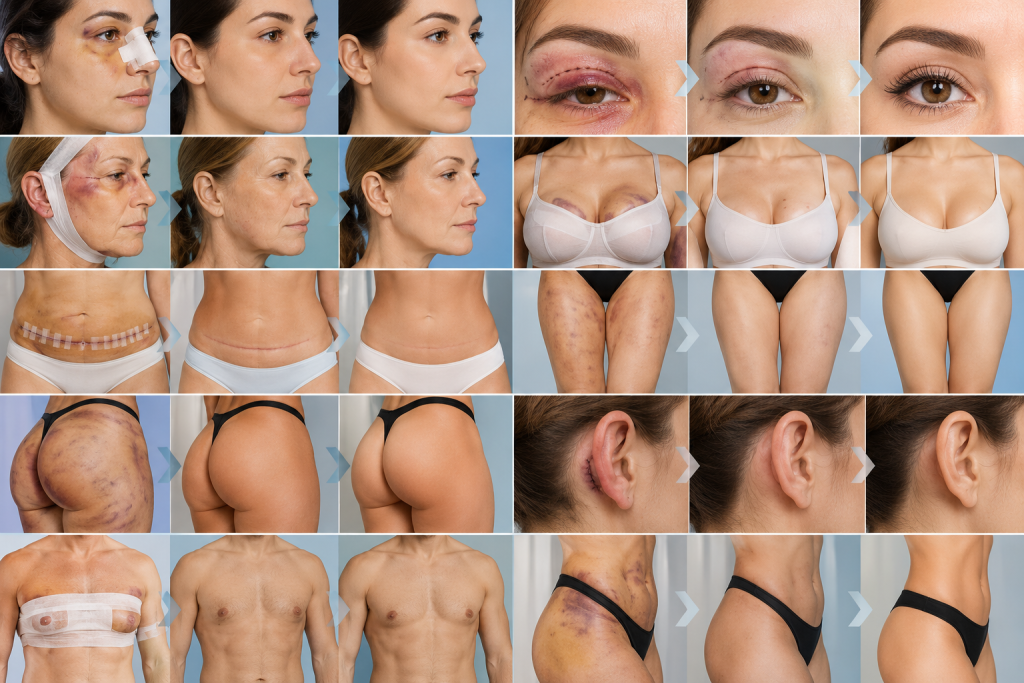
Understanding the first, second, and third stages of recovery after plastic surgery
Cosmetic surgery recovery is a gradual process. Although patients often focus on the first few days after an operation, complete healing can take weeks or months, depending on the procedure.
Understanding the three phases of cosmetic surgery recovery helps patients prepare for their treatment, arrange time away from work, plan their travel, and develop realistic expectations about their results.
At Chic Clinic Istanbul, we encourage patients to understand that recovery is not identical for everyone. Age, general health, smoking, nutrition, surgical technique, and adherence to postoperative instructions can all influence healing.
In this guide, we compare the three recovery phases of ten popular cosmetic surgery procedures, including rhinoplasty, liposuction, tummy tuck, BBL, breast surgery, facelift, blepharoplasty, otoplasty, and gynecomastia surgery.
What Are the Three Phases of Cosmetic Surgery Recovery?
For practical purposes, recovery can be divided into three overlapping stages.
Phase 1: Early Recovery
This is the initial healing period, when swelling, bruising, discomfort, and fatigue are often most noticeable.
Patients may need assistance with daily activities, medication, wound care, compression garments, or specific sleeping positions.
Phase 2: Intermediate Recovery
During this stage, swelling and discomfort generally decrease. Many patients gradually return to work, walking, and normal daily routines.
However, deeper tissues continue to heal, and strenuous exercise may still be restricted.
Phase 3: Long-Term Healing
During the final stage, residual swelling gradually resolves, scars mature, and surgical results become more defined.
Importantly, the end of the initial recovery period does not mean that all tissues have completely healed.
The following timelines are approximate educational ranges, not fixed medical deadlines. The phases may overlap, and your surgeon’s individualized instructions always take priority.
1. Rhinoplasty Recovery Timeline
Rhinoplasty reshapes the nose by modifying cartilage, bone, or both. Recovery involves changes in swelling, nasal breathing, and the gradual refinement of the nasal contours.
| Recovery phase | Typical timeline | What to expect |
|---|---|---|
| Phase 1: Early | Days 1–14 | Nasal congestion, swelling, bruising, splint care, and rest |
| Phase 2: Intermediate | Weeks 3–8 | Visible swelling decreases, daily routines resume, and activity gradually increases |
| Phase 3: Long-term | Months 2–12 or longer | Residual swelling subsides and the nasal tip becomes more defined |
Returning to work: Many patients with desk jobs return within approximately 1–2 weeks.
Returning to exercise: Light activity may resume earlier, while strenuous exercise generally requires several weeks and surgeon approval.
Final results: Nasal refinement commonly continues for 12 months, sometimes longer, particularly after complex or revision surgery.
2. Liposuction Recovery Timeline
Liposuction removes localized fat deposits through small incisions. The recovery period depends on the number and size of the treated areas and whether additional procedures are performed.
| Recovery phase | Typical timeline | What to expect |
|---|---|---|
| Phase 1: Early | Days 1–7 | Swelling, bruising, fluid drainage, soreness, and compression garments |
| Phase 2: Intermediate | Weeks 2–6 | Improved mobility, reduced discomfort, and gradual return to activities |
| Phase 3: Long-term | Months 2–6 or longer | Continued swelling reduction and refinement of body contours |
Returning to work: Some patients return to nonphysical work within several days to two weeks.
Returning to exercise: More demanding activities are commonly resumed after approximately 4–6 weeks, depending on the extent of surgery.
Final results: Contours often become clearer over 3–6 months, although swelling can persist longer.
3. Tummy Tuck Recovery Timeline
Abdominoplasty, commonly known as a tummy tuck, removes excess abdominal skin and may include tightening of the abdominal wall.
Because this operation can involve extensive tissue repair, recovery is generally more demanding than recovery from limited liposuction.
| Recovery phase | Typical timeline | What to expect |
|---|---|---|
| Phase 1: Early | Weeks 1–2 | Abdominal tightness, restricted movement, incision care, and possible drains |
| Phase 2: Intermediate | Weeks 3–8 | Gradually improved posture and mobility, with continued lifting restrictions |
| Phase 3: Long-term | Months 2–12 or longer | Reduction of residual swelling and gradual scar maturation |
Returning to work: Desk work may be possible after approximately 2–4 weeks.
Returning to exercise: Heavy lifting and abdominal exercise often remain restricted for at least 6–8 weeks, sometimes longer.
Final results: Abdominal contours improve as swelling resolves, while scars may continue maturing for 12–18 months or longer.
4. Brazilian Butt Lift (BBL) Recovery Timeline
A Brazilian Butt Lift combines liposuction with fat transfer to the buttocks.
Recovery involves both the areas where fat was removed and the areas where fat was transferred.
| Recovery phase | Typical timeline | What to expect |
|---|---|---|
| Phase 1: Early | Weeks 1–2 | Swelling, bruising, compression, and restrictions on pressure over the buttocks |
| Phase 2: Intermediate | Weeks 3–8 | Improved mobility, gradual activity increases, and continued changes in transferred fat volume |
| Phase 3: Long-term | Months 2–6 or longer | Swelling reduction and stabilization of the surviving fat volume |
Returning to work: Some patients return to nonphysical work within approximately 2–3 weeks, provided pressure restrictions can be accommodated.
Sitting restrictions: The surgeon may recommend avoiding prolonged direct pressure on the buttocks during the early healing period.
Final results: The transferred fat volume generally becomes more stable over several months.
Important safety note: BBL carries specific risks, including potentially fatal fat embolism. Patients should choose appropriately qualified surgeons who follow current safety recommendations, including safe injection techniques and appropriate ultrasound guidance.
5. Breast Augmentation Recovery Timeline
Breast augmentation uses implants to increase breast volume or modify breast shape.
Recovery varies according to implant placement, incision location, and whether other breast procedures are performed.
| Recovery phase | Typical timeline | What to expect |
|---|---|---|
| Phase 1: Early | Days 1–10 | Chest tightness, soreness, swelling, and limited arm movements |
| Phase 2: Intermediate | Weeks 2–6 | Reduced discomfort and gradual return to normal activities |
| Phase 3: Long-term | Months 2–6 or longer | Continued softening and settling of the breasts |
Returning to work: Nonphysical work may be possible within approximately 1–2 weeks.
Returning to exercise: Upper-body training and heavy lifting generally require several weeks of restriction.
Final results: Breast shape continues to evolve as swelling decreases and tissues adapt.
6. Breast Lift Recovery Timeline
A breast lift, or mastopexy, reshapes and elevates the breasts by removing excess skin and repositioning breast tissue.
| Recovery phase | Typical timeline | What to expect |
|---|---|---|
| Phase 1: Early | Weeks 1–2 | Swelling, bruising, incision care, and use of a supportive bra |
| Phase 2: Intermediate | Weeks 3–6 | Improved comfort and gradual return to daily activities |
| Phase 3: Long-term | Months 2–12 or longer | Breast shape settles and scars gradually mature |
Returning to work: Many patients return to desk work after approximately 1–2 weeks.
Returning to exercise: Strenuous upper-body activity often requires 4–6 weeks or longer.
Final results: Breast shape may settle over several months, while scars continue improving for a year or more.
7. Facelift Recovery Timeline
A facelift addresses selected signs of facial aging by repositioning facial tissues and removing excess skin.
The extent of surgery influences bruising, swelling, and the recovery period.
| Recovery phase | Typical timeline | What to expect |
|---|---|---|
| Phase 1: Early | Weeks 1–2 | Facial swelling, bruising, tightness, and incision care |
| Phase 2: Intermediate | Weeks 3–6 | More natural appearance as visible swelling decreases |
| Phase 3: Long-term | Months 2–12 | Residual swelling resolves and scars continue maturing |
Returning to work: Many patients plan approximately 2–3 weeks away from public-facing work.
Returning to exercise: Strenuous exercise often remains restricted for several weeks.
Final results: Facial contours become progressively more refined over the following months.
8. Blepharoplasty Recovery Timeline
Blepharoplasty removes or repositions excess skin and, when indicated, fat around the eyelids.
Upper and lower eyelid procedures may have different recovery requirements.
| Recovery phase | Typical timeline | What to expect |
|---|---|---|
| Phase 1: Early | Days 1–10 | Eyelid swelling, bruising, dryness, and temporary discomfort |
| Phase 2: Intermediate | Weeks 2–4 | Most visible bruising improves and daily activities resume |
| Phase 3: Long-term | Months 1–6 or longer | Residual swelling decreases and incision lines mature |
Returning to work: Many patients resume desk work within approximately 7–14 days.
Returning to exercise: Strenuous activity may need to be avoided for several weeks.
Final results: Eyelid appearance continues to improve as swelling resolves.
Patients experiencing severe eye pain, sudden vision changes, or rapidly increasing swelling require urgent medical assessment.
9. Otoplasty Recovery Timeline
Otoplasty changes the shape or position of the ears, often to reduce their prominence.
| Recovery phase | Typical timeline | What to expect |
|---|---|---|
| Phase 1: Early | Days 1–10 | Ear swelling, tenderness, dressings, and protection from pressure |
| Phase 2: Intermediate | Weeks 2–6 | Improved comfort and gradual return to daily routines |
| Phase 3: Long-term | Months 2–6 or longer | Residual swelling settles and scars mature |
Returning to work: Many adults can resume nonphysical work within approximately one week.
Returning to exercise: Contact sports and activities that may injure the ears often require longer restrictions.
Final results: Ear shape becomes clearer as swelling decreases.
10. Gynecomastia Surgery Recovery Timeline
Gynecomastia surgery reduces excess male breast tissue and may involve gland removal, liposuction, or both.
| Recovery phase | Typical timeline | What to expect |
|---|---|---|
| Phase 1: Early | Days 1–14 | Chest soreness, bruising, swelling, and compression garments |
| Phase 2: Intermediate | Weeks 3–6 | Improved comfort and gradual return to physical activities |
| Phase 3: Long-term | Months 2–6 or longer | Continued contour refinement and scar maturation |
Returning to work: Nonphysical work may be possible after approximately 1–2 weeks.
Returning to exercise: Chest training and heavy lifting are commonly restricted for 4–6 weeks or longer.
Final results: Chest contours improve over several months as swelling resolves.
Cosmetic Surgery Recovery Timeline: Quick Comparison
The following table summarizes approximate recovery milestones for uncomplicated procedures.
| Procedure | Early phase | Intermediate phase | Long-term phase |
|---|---|---|---|
| Rhinoplasty | 1–2 weeks | Weeks 3–8 | Up to 12+ months |
| Liposuction | 1 week | Weeks 2–6 | 2–6+ months |
| Tummy tuck | 1–2 weeks | Weeks 3–8 | Up to 12+ months |
| BBL | 1–2 weeks | Weeks 3–8 | 2–6+ months |
| Breast augmentation | 1–10 days | Weeks 2–6 | 2–6+ months |
| Breast lift | 1–2 weeks | Weeks 3–6 | Up to 12+ months |
| Facelift | 1–2 weeks | Weeks 3–6 | Up to 12 months |
| Blepharoplasty | 1–10 days | Weeks 2–4 | 1–6+ months |
| Otoplasty | 1–10 days | Weeks 2–6 | 2–6+ months |
| Gynecomastia surgery | 1–2 weeks | Weeks 3–6 | 2–6+ months |
These phases are descriptive rather than standardized clinical classifications. They overlap, and the timing of work, exercise, travel, and final results must be assessed separately.
What Can Delay Cosmetic Surgery Recovery?
Several factors can prolong healing, including smoking or nicotine use, poorly controlled medical conditions, nutritional deficiencies, infection, extensive surgery, and complications involving wound healing.
Combining multiple procedures can also increase recovery demands.
Patients should follow their surgeon’s instructions regarding medications, compression garments, activity restrictions, nutrition, and follow-up appointments.
When Should You Contact Your Surgeon?
Some discomfort, bruising, and swelling are expected after cosmetic surgery. However, certain symptoms require immediate attention.
Seek urgent medical care for chest pain, sudden shortness of breath, fainting, or signs of a stroke.
Contact your surgical team promptly for fever, increasing redness, worsening pain, unusual wound discharge, sudden asymmetrical swelling, or other unexpected symptoms.
Patients should not assume that every postoperative symptom is a normal part of recovery.
When Can You Fly After Cosmetic Surgery in Turkey?
For international patients traveling to Istanbul, recovery planning must include the return flight.
Flying too soon after surgery may increase discomfort and can be particularly concerning when prolonged immobility contributes to blood clot risk.
There is no universal safe flying date for every cosmetic procedure. The appropriate timing depends on the operation, the patient’s risk factors, postoperative progress, flight duration, and the surgeon’s assessment.
Patients should arrange sufficient time for postoperative examinations before returning home.
Cosmetic Surgery Recovery at Chic Clinic Istanbul
At Chic Clinic Istanbul, we help international patients understand the expected recovery process before scheduling their procedures.
Our patient coordination team can assist with treatment planning, accommodation arrangements, airport transfers, and communication regarding postoperative follow-up.
Because each procedure has different recovery requirements, treatment and travel schedules should be planned individually with the surgical team.
Frequently Asked Questions
Which cosmetic surgery has the shortest recovery time?
Limited procedures such as certain eyelid or ear surgeries may allow a relatively quick return to nonphysical work. However, complete healing still takes longer than the initial recovery period.
Which cosmetic surgery requires the longest recovery?
More extensive procedures, such as tummy tuck surgery or combinations of multiple operations, can require longer activity restrictions. Rhinoplasty may also involve a particularly long period of subtle swelling and final-result refinement.
Does feeling better mean I am completely healed?
No. Pain and bruising may improve before deeper tissues have regained sufficient strength for demanding activities.
Can I exercise during the second recovery phase?
Light walking is often encouraged early, but strenuous exercise must be resumed according to the specific procedure and the surgeon’s instructions.
How long does it take for cosmetic surgery scars to fade?
Scars typically change over many months. Scar maturation commonly takes 12–18 months and may take longer in some patients.
Final Thoughts
The three phases of cosmetic surgery recovery help explain why returning to everyday activities and achieving final surgical results are two different milestones.
While many patients feel significantly better within the first few weeks, swelling reduction, tissue remodeling, and scar maturation can continue for months.
Understanding these differences allows patients to plan their recovery more realistically and make informed decisions about their treatment.
Considering cosmetic surgery in Istanbul? Contact Chic Clinic Istanbul to discuss your treatment options, expected recovery timeline, and individualized postoperative care plan.