
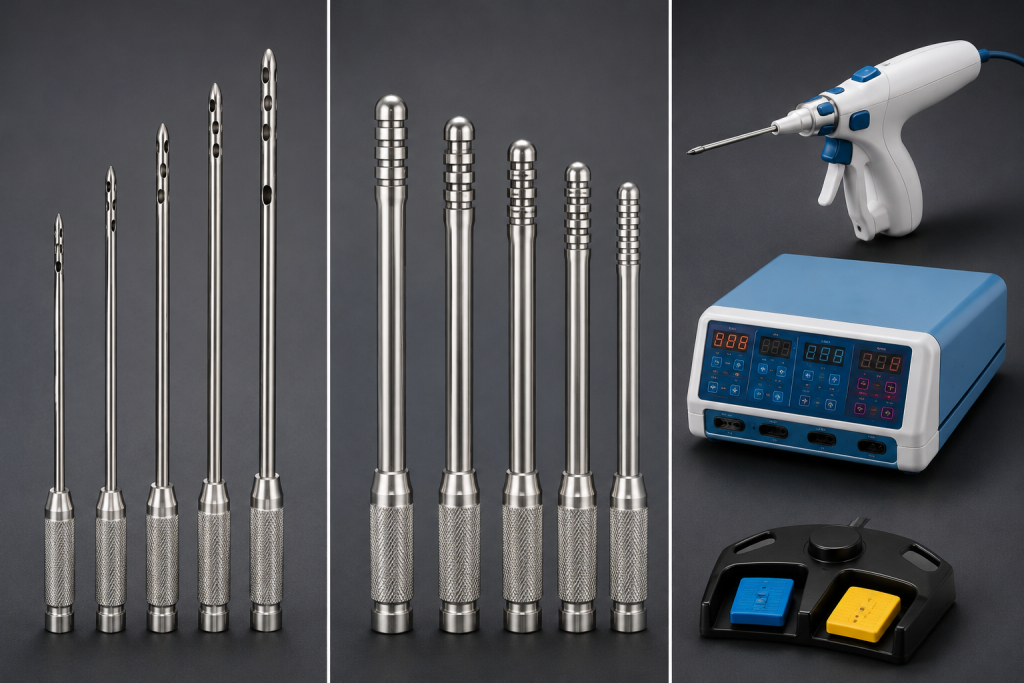
Types of Liposuction include different techniques such as Classic Liposuction, VASER Liposuction, Laser Lipolysis, and technologies such as J-Plasma used alongside liposuction. Each method uses a different technology and serves a different purpose in fat removal, body contouring, and skin tightening.
Introduction
If you are researching body contouring and localized fat removal, you have probably come across terms such as Classic Liposuction, VASER Liposuction, Laser Lipolysis, and J-Plasma. But what are the differences between liposuction types, and which technology may be more suitable for your body?
An important point is that these terms do not all describe exactly the same type of treatment. Classic Liposuction, VASER, and Laser Lipolysis are techniques used to assist with fat removal, while J-Plasma is primarily used to promote tissue contraction and improve skin laxity, usually in combination with liposuction.
In this guide, we explain the differences between these technologies, their purposes, and how an appropriate body contouring technique is selected.
What Is Liposuction?
Liposuction is a surgical procedure designed to remove localized fat deposits and improve body contours.
During the procedure, the surgeon inserts a thin tube called a cannula through small incisions. The excess fat is then removed from the targeted areas.
Liposuction can be performed on several areas of the body, including:
- Abdomen
- Flanks
- Waist and lower back
- Thighs
- Arms
- Under the chin
- Back
- Selected areas around the chest
It is important to understand that liposuction is not primarily a weight-loss procedure. Its main purpose is to remove localized fat deposits and create a more balanced and defined body contour.
What Is Classic Liposuction?
Classic Liposuction, also known as traditional liposuction, is one of the most established techniques for surgical fat removal.
During the procedure, a special solution is typically injected into the fatty tissue. The surgeon then uses a cannula and suction system to remove the excess fat.
Advantages of Classic Liposuction
- A well-established surgical technique
- Suitable for different areas of the body
- Can remove significant amounts of localized fat in appropriately selected patients
- Allows body contouring through controlled fat removal
The final result depends greatly on the surgeon’s experience, the amount and distribution of fat, skin quality, and the patient’s anatomy.
What Is VASER Liposuction?
VASER stands for Vibration Amplification of Sound Energy at Resonance.
Unlike classic liposuction, VASER uses ultrasound energy to act on fatty tissue before it is removed.
A specialized VASER probe is inserted into the treatment area. The ultrasound energy helps prepare and separate the fatty tissue, after which the fat is removed using liposuction cannulas.
This can give the surgeon greater control when sculpting specific areas of the body.
Advantages of VASER Liposuction
Depending on the patient and treatment area, VASER may offer advantages such as:
- More precise body contouring
- Detailed sculpting of selected areas
- Use in High Definition Liposuction
- Greater control when working around natural muscle contours
- Possibility of using harvested fat for fat transfer when appropriate
For this reason, VASER is frequently considered when the objective is not simply reducing fat volume but achieving more detailed body definition.
What Is High Definition VASER Liposuction?
High Definition Liposuction (HD Lipo) is an advanced body contouring approach designed to enhance the natural lines of the muscles.
For example, selective fat removal around the abdominal muscles may make the underlying muscular definition more visible.
Some techniques are also commonly referred to as Six-Pack Liposuction or Abdominal Etching.
However, not everyone is a suitable candidate for HD Liposuction. The outcome depends on factors such as:
- Amount of body fat
- Muscle development
- Skin elasticity
- Body anatomy
- Patient expectations
A detailed medical evaluation is therefore necessary before choosing this technique.
What Is Laser Lipolysis?
Laser Lipolysis, sometimes called laser-assisted liposuction, uses laser energy and heat to act on fatty tissue.
The technology became popular as an alternative approach to body contouring and was used particularly for selected smaller treatment areas.
However, body contouring technology has continued to evolve. In many modern aesthetic surgery centers in Turkey, technologies such as VASER and other advanced body contouring techniques have largely replaced older laser-based approaches.
Is Laser Lipolysis Still Performed at Chic Clinic Istanbul?
No. Laser Lipolysis is not performed at Chic Clinic Istanbul.
It is no longer one of the technologies used by our clinic for liposuction and body contouring. Instead, more modern techniques are selected according to the patient’s anatomy, skin quality, fat distribution, and treatment goals.
The use of Laser Lipolysis has also become considerably less common than in the past in many modern cosmetic surgery centers in Turkey, where newer body contouring technologies such as VASER Liposuction are often preferred.
Why Is Laser Lipolysis Used Less Frequently?
One of the main differences between Laser Lipolysis and VASER is the type of energy used.
Laser Lipolysis uses laser-generated heat, whereas VASER uses ultrasound energy to act on fatty tissue before extraction.
Advances in body contouring technology have provided surgeons with additional options for precise fat removal and body sculpting. As a result, older laser-assisted techniques are no longer the primary choice in many modern surgical centers.
The appropriate technique should nevertheless always be selected according to the individual patient and the surgeon’s medical assessment.
What Is J-Plasma?
One of the most important things to understand about J-Plasma is that it is not simply another type of liposuction.
J-Plasma technology, associated with helium plasma and radiofrequency (RF) energy, is primarily used to promote controlled contraction of tissue beneath the skin.
For this reason, J-Plasma may be used in combination with or following liposuction, rather than as a replacement for fat removal itself.
How Does Liposuction + J-Plasma Work?
Consider a patient who has a significant amount of fat removed from the abdomen, waist, or flanks.
After fat removal, the skin and underlying tissues may not contract as much as desired, particularly in patients with reduced skin elasticity.
In selected patients, J-Plasma may then be used to promote tissue contraction and improve the appearance of skin laxity.
In simple terms:
Liposuction → Fat Removal
J-Plasma → Tissue Contraction / Skin Tightening Support
Therefore, these two treatments can complement each other.
What Is the Difference Between VASER and J-Plasma?
VASER and J-Plasma are two different technologies designed for different purposes.
VASER primarily works on fatty tissue using ultrasound energy and assists the surgeon during fat removal and body contouring.
J-Plasma primarily targets the tissue beneath the skin to promote contraction after body contouring.
For this reason, both technologies may sometimes be used during the same operation:
VASER → Fat Preparation and Removal → J-Plasma → Tissue Contraction
The exact combination depends on the patient’s individual needs.
Classic Liposuction vs VASER vs Laser vs J-Plasma
| Technique | Technology | Main Purpose |
|---|---|---|
| Classic Liposuction | Cannula + suction | Removal of localized fat |
| VASER Liposuction | Ultrasound energy | Fat removal and detailed body contouring |
| Laser Lipolysis | Laser energy | Older heat-based technology for treating fatty tissue; not performed at Chic Clinic |
| J-Plasma | Helium plasma + RF energy | Tissue contraction and improvement of skin laxity |
Can J-Plasma Replace Surgery for Excess Skin?
Not in every patient.
J-Plasma may help improve certain degrees of skin laxity, but it cannot replace surgical skin removal in all cases.
For example, a patient who has lost a large amount of weight and has significant hanging abdominal skin may require an abdominoplasty (Tummy Tuck).
In such cases, a skin-tightening technology alone cannot necessarily achieve the same result as surgical removal of excess skin.
Therefore, it is important to distinguish between mild or moderate skin laxity and a significant amount of excess skin.
Which Type of Liposuction Is Best?
There is no single liposuction technique that is best for every patient.
The surgeon should consider several factors before choosing the appropriate treatment, including:
- Amount of fat
- Location of fat deposits
- Skin quality and elasticity
- Body anatomy
- History of weight loss
- Muscle definition
- Desired result
- General health
For some patients, Classic Liposuction may be sufficient. For others, VASER Liposuction or a combination such as VASER + J-Plasma may be considered.
A newer or more expensive technology does not automatically mean that it is the best choice for every patient.
Can Removed Fat Be Transferred to Another Area?
In many cases, yes.
When appropriate, harvested fat can be processed and used for Fat Transfer to another part of the body.
One of the best-known examples is the Brazilian Butt Lift (BBL), in which fat is removed from areas such as the abdomen, flanks, or back and transferred to the buttocks to improve shape and volume.
Fat transfer procedures should be performed using appropriate techniques and strict safety protocols.
Recovery After Liposuction
Recovery depends on the extent of surgery, the areas treated, and the techniques used.
During the first days and weeks, patients may experience:
- Swelling
- Bruising
- Tightness
- Tenderness
- Temporary firmness in the treated areas
A compression garment is also commonly recommended after liposuction according to the surgeon’s instructions.
Swelling gradually decreases over time, and the final body contour may take several months to become fully visible.
Are Liposuction Results Permanent?
Fat cells removed during liposuction are removed from the treated area. However, this does not mean that the patient can never gain weight again.
If significant weight gain occurs, the remaining fat cells can enlarge and alter the body’s contours.
Maintaining a stable weight, following a balanced diet, and staying physically active can therefore help preserve the results.
Conclusion
The differences between liposuction types mainly relate to the technology used and the purpose of each treatment.
Classic Liposuction is an established method for removing localized fat. VASER Liposuction uses ultrasound energy to assist fat removal and enable more detailed body contouring. Laser Lipolysis is an older laser-based approach that is no longer performed at Chic Clinic Istanbul and has become less commonly used in many modern aesthetic surgery centers in Turkey. J-Plasma, on the other hand, is primarily used to promote tissue contraction and improve skin laxity in combination with liposuction.
For many patients, choosing the correct technique—or combination of techniques—is more important than simply choosing a particular device. The final treatment plan should be based on the amount of fat, skin elasticity, anatomy, medical condition, and the patient’s desired result.