
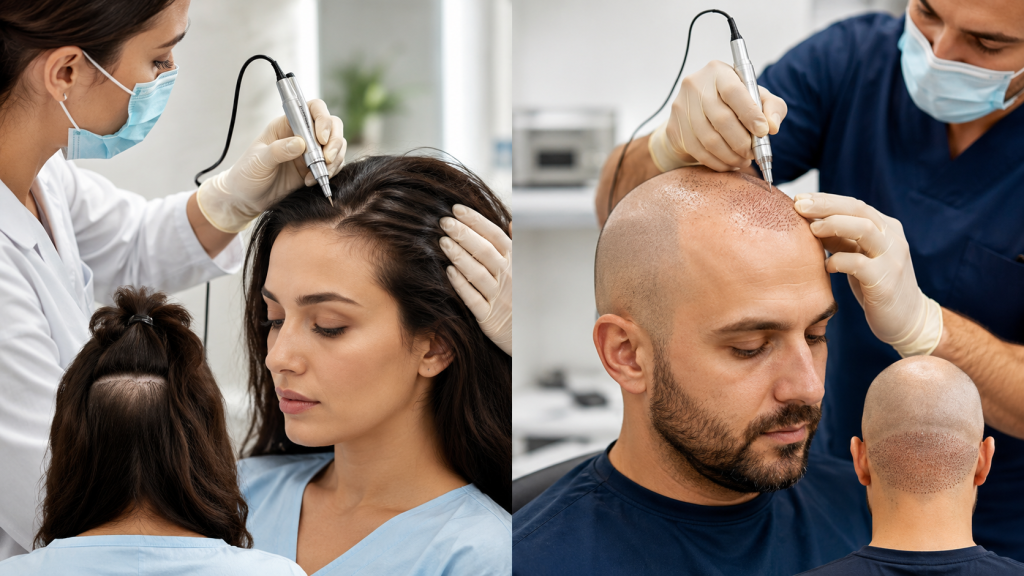
DHI and FUE are two of the most popular hair transplant techniques, but they are not always recommended for the same type of patient. The main difference is usually related to the shaving process, the size of the bald area, and the patient’s expectations.
In the DHI method, the entire hair is usually not shaved completely. In many cases, only a small donor area at the back of the head is shaved in order to extract the hair follicles. These follicles are then implanted into the thinning or bald areas, usually in the front part of the scalp. Because the visible hair does not need to be fully shaved, DHI is often preferred by women or by patients who want to keep their existing hairstyle as much as possible.
DHI can be a good option when the bald area is limited. For example, if the patient only has thinning in the frontal hairline or a small area of hair loss, DHI may be suitable. This is one of the reasons why DHI is more commonly recommended for female patients or for people who are sensitive about cutting their hair very short.
In the FUE method, the hair is usually shaved more extensively before the procedure. This makes it easier to extract grafts from the donor area and implant them into larger bald areas. FUE is generally more suitable for patients with more advanced hair loss, wider bald areas, or more extensive thinning.
In simple terms, DHI is usually preferred when the patient does not want a fully shaved look and needs treatment for a smaller area. FUE is usually preferred when the patient has more significant baldness and needs a larger number of grafts.
Many patients also ask which method gives better results. The answer depends on the patient’s hair loss pattern, donor area, hair quality, and the number of grafts needed. However, for larger transplant sessions, FUE can often be more practical and efficient. It may also be more comfortable for cases that require broader coverage.
DHI can still be a strong option for patients who are very concerned about keeping their hair long or avoiding a fully shaved appearance. If not shaving the full head is a major priority, DHI may be considered even if the process is more detailed and time-consuming.
A typical hair transplant procedure usually takes around 6 to 8 hours. During the procedure, hair follicles are extracted one by one from the donor area at the back of the head. These grafts are then carefully implanted into the target areas to improve density, restore the hairline, and create a natural-looking result.
The best choice between DHI and FUE should always be made after a personal evaluation. The right technique depends on the size of the bald area, the condition of the donor area, the patient’s gender, hairstyle preferences, and the final result the patient wants to achieve.